
Writing Desk: What Height, Depth and Tabletop Suit Writing and Work?
In short
A good writing desk comes down to three numbers: depth, height and width. Writing in a notebook needs at least 45 cm of depth and 60 cm for comfort, a height at which the elbows stay at about 90 degrees (roughly 0.4 of body height), and 120 cm or more of width if there is also a computer or a lamp. Rounded edges prevent pressure on the forearms, and drawers under the desk reduce leg room, so it is better to put them beside the chair. Work with two monitors, or two people at one desk, needs 140 to 180 cm.
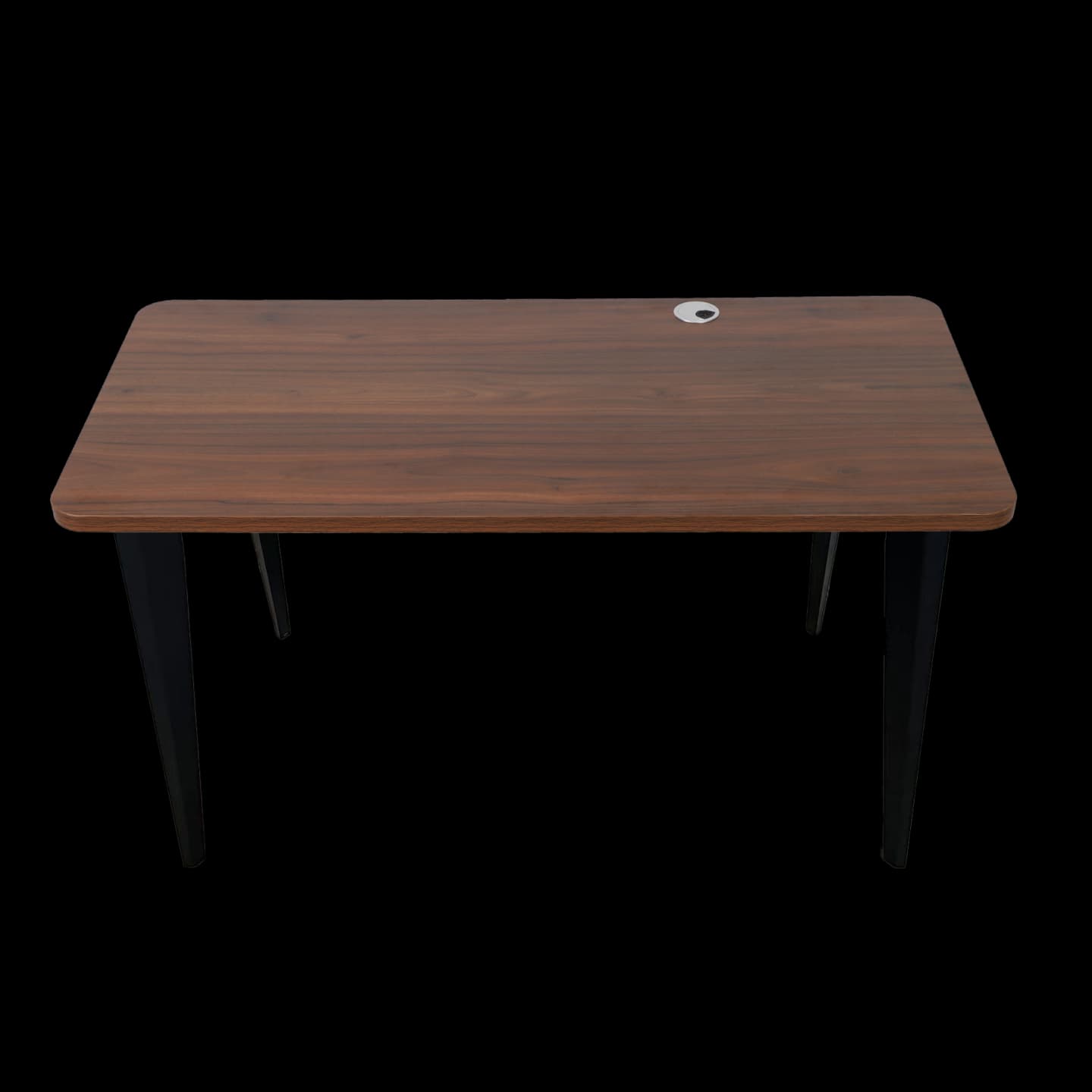
Writing desk, computer desk and work desk: the real difference
The three names describe the same basic product: a flat surface on legs. What sets them apart is what you put on it, so that is the question to start from. Someone who only writes and studies needs less width than someone working with two monitors, but both need the same height and the same kind of edges.
| Use | What is on the desk | Recommended size | Why |
|---|---|---|---|
| Writing and studying | Notebooks, books, a lamp | 120x60 | An open A4 notebook takes about 42 cm and leaves room for a lamp and a cup |
| Laptop and notebook | Laptop, mouse, notebook | 120x60, or 140x70 for comfort | A laptop is about 30 cm wide, plus a notebook and a mouse |
| Desktop PC with one monitor | 24 to 27-inch monitor, keyboard, mouse | 120x60, and 140x70 for a 27-inch screen | A 24-inch monitor is about 53 cm wide and a 27-inch about 60 cm |
| Working from home with two monitors | Two monitors, keyboard, mouse, documents | 140x70 to 160x80 | See the width calculation in the size guide |
| Desk shared by two people | A laptop or monitor each | 160x80 to 180x80 | Each person needs 73 to 93 cm with a 24-inch monitor |
The values are computed from the size of the gear and from our width formula: the sum of the gear plus 20 to 40 cm. They are a planning estimate and not a standard.
How much space writing needs
An A4 sheet is 21x29.7 cm. An open A4 notebook therefore takes about 42 cm of width and 30 cm of depth, and you should add at least 15 cm of depth so the forearms rest on the desk and not on the edge. Writing alone is possible at a depth of 45 cm, which is also the minimum depth our legs can be assembled on, but 60 cm is far more comfortable and leaves room for a lamp or a monitor.
If there is also a desktop computer, depth takes on another meaning. OSHA, the US Occupational Safety and Health Administration, states that the depth should allow a distance of at least 50 cm from the eyes to the screen. With 27-inch screens and larger, that means 70 cm of depth or more.
Height: a simple check before you buy
Desk height sets the angle of your elbows and shoulders. When the desk is too high the shoulders rise, and when it is too low the back bends. The ideal sitting height is about 0.4 of body height, an average proportion from body-segment research that we cross-checked against OSHA guidance. A person 175 cm tall suits a desk of about 70 cm, and a person 180 cm tall a desk of about 72 cm. The desk height calculator works it out from your own height.
Sit properly
Feet flat on the floor and your back against the chair.
Place your hands
Upper arms relaxed at your sides and forearms parallel to the floor.
Check the height
The desk surface should be at forearm height, so the elbow is at about 90 degrees and the shoulders are relaxed.
Adjust as needed
If the desk is high, raise the chair and add a footrest. If it is low, OSHA suggests raising the desk legs with stable supports.
Our writing desk is 72 cm high, a fixed height. It suits mainly people 170 to 190 cm tall. Shorter people, and children and teenagers who are still growing, are better served by an adjustable desk. More in the guide to adjustable desks for kids.
Tabletop and edges: what matters when you write for hours
- Rounded edges. When the forearms rest on a sharp edge, pressure builds up that can affect nerves and blood vessels and end up feeling like tingling in the fingers. OSHA recommends choosing furniture with rounded edges and, if there is no choice, padding the edge. Our tabletops have rounded corners.
- A matte surface. A matte surface reflects less light from the desk lamp and the ceiling lights, so it is easier on the eyes for reading and writing over time.
- Durability and cleaning. A 18 mm melamine tabletop resists scratches and stains and wipes clean with a damp cloth. Other materials are compared in the tabletop materials guide.
- A cable opening. With a laptop or a lamp, an opening with a cover keeps the desk tidy and keeps cables from getting in the way of writing.
Drawers and storage without giving up leg room
A classic writing desk has drawers, but OSHA warns that too little space under the work surface limits your ability to change posture and can cause shoulder, back and neck pain. The advice is to keep the space under the desk free of files and boxes and, if needed, to remove a center drawer to gain thigh room.
Our solution is a rolling metal drawer unit, 60x39x50 cm, with a lockable top drawer. It slides under the desk when you are not sitting, and when you sit you roll it aside so it does not restrict your legs.


When a fixed writing desk is not suitable
- If you sit more than a few hours a day. Long sitting without breaks is a problem in itself, and even a perfect desk does not solve it. You can combine standing with an adjustable desk.
- If your height is far from 180 cm. For people under 160 cm or over 195 cm, a fixed-height desk will not fit correctly.
- If you draw on large sheets. An A2 sheet is 42x59.4 cm, so you need at least 80 cm of depth to leave room for the forearms.